
Introduction
Many organizations have used DocuSign for years to sign and store all kinds of documents, including customer and vendor contracts, NDAs, internal forms, and partner records. These documents are usually organized by an identifier such as a contract ID, partner ID, or record ID.
When the DocuSign contract is expiring and the organization decides to stop using the service, every signed document must be moved out before the deadline, because once the account is closed, those documents may no longer be recoverable. IIG helps organizations move their complete signing history from DocuSign into Box through a direct API-to-API migration that preserves document structure and adds searchable metadata, without a manual export step.
Why Box Becomes the Home for Signed Documents
In this model, Box serves as the central content repository responsible for retention, legal hold, and records management. Business systems such as ERP, CRM, or other management software handle transactions only, while the documents themselves live in Box and are accessed through the Box API.
This separation means signed records are governed in one place. When business applications change in the future, the documents do not need to be migrated again.
The IIG Approach: Direct API-to-API Migration
For each envelope, the worker lists the envelope, downloads the signed documents and the Certificate of Completion, stages them temporarily in an environment owned by the organization, and uploads them to Box using an agreed folder structure, such as /{Department}/{Identifier}/. A Box metadata template tags each file with the envelope ID, identifier, completion date, signer, and document type, so users can search by metadata as well as by full text.

The content itself adds complexity. Each envelope can contain multiple documents, along with a Certificate of Completion and audit trail that must be kept as legal evidence. Signed documents often contain sensitive information that requires tight security and permissions, and the DocuSign API enforces a default rate limit of 3,000 calls per hour per account.
Reliability, Verification, and Security by Design
The migration is built to run safely at scale. Checkpoints allow the process to be re-run without creating duplicates, and the worker automatically retries when it encounters errors or rate limits. Every file is verified using the SHA1 value returned by Box, and a reconciliation report compares counts between the two systems.
Security follows the principle of least privilege. Access uses single sign-on through Azure AD, sensitive folders are restricted to the appropriate user groups, and the migration team does not open document contents. Additional protection, such as Box Shield, can be applied as an option.

Why Off-the-Shelf Tools Are Not Enough
No off-the-shelf tool migrates the complete DocuSign history into Box. Box Shuttle does not support DocuSign as a source, and DocuSign-to-Box connectors either serve new signing activity only or place every document into a single folder. The DocuSign web interface also does not support bulk download of thousands of envelopes.
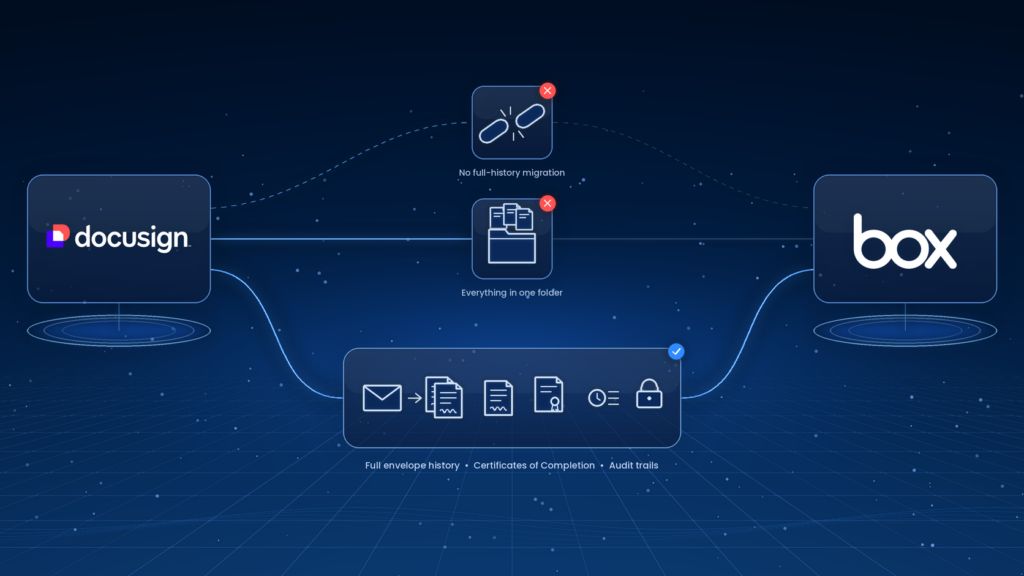
The content itself adds complexity. Each envelope can contain multiple documents, along with a Certificate of Completion and audit trail that must be kept as legal evidence. Signed documents often contain sensitive information that requires tight security and permissions, and the DocuSign API enforces a default rate limit of 3,000 calls per hour per account.
A Phased Rollout From Inventory to Account Closure
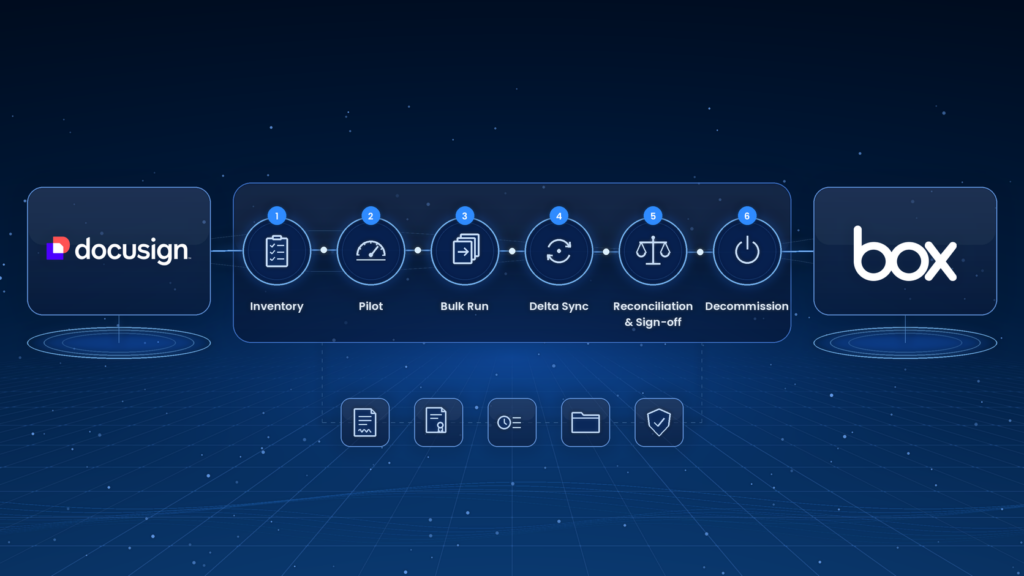
The migration follows six phases, so the organization can measure, verify, and sign off before DocuSign is decommissioned:
| 1. Inventory | Count envelopes, documents, and total volume. |
| 2. Pilot | Run a pilot to measure throughput. |
| 3. Bulk run | Migrate the full envelope history through the APIs. |
| 4. Final delta sync | Capture any envelopes completed since the bulk run. |
| 5. Reconciliation and sign-off | Compare counts between DocuSign and Box and obtain sign-off. |
| 6. Decommission | Delete data in DocuSign and close the account. |
For roughly ten thousand envelopes, API run time is measured in hours. The whole project, including the pilot and sign-off, fits within a few weeks.
The Value of Moving DocuSign Records to Box
A direct DocuSign to Box migration allows organizations to decommission DocuSign on time without losing documents. The document structure is preserved, and metadata is added so signed records can be found through search.
With documents consolidated in one central repository, no further migration is needed when business systems change later. Organizations also lower license costs and simplify compliance and records retention.
Conclusion
Retiring an eSignature platform should not put signed records at risk. By combining direct API integration, metadata, verification, and least-privilege security, IIG helps organizations move their DocuSign history into Box completely and defensibly, and establish a governed content repository that will outlast future system changes.
About IIG
Information Intelligence Group (IIG) delivers mission‑critical automation solutions that transform high‑volume, manual, paper‑based processes into secure, auditable, and scalable digital systems—supporting enterprise organizations across government and the private sector.