
Introduction:
Manual processes often depend on email, spreadsheets, paper folders, shared drives, and personal follow-up. While these tools may work for small volumes, they become risky when programs involve deadlines, approvals, statutory requirements, sensitive records, and multiple teams.
Process automation gives organizations a controlled way to move work from intake to resolution. With IIG, complex business processes can be modeled as secure, auditable workflows that route tasks, enforce rules, track decisions, and provide real-time visibility into performance.
What Is Process Automation?
Process automation is the use of digital workflows, business rules, role-based routing, notifications, and system integrations to reduce manual handoffs and standardize how work gets completed. It helps organizations ensure that the right task goes to the right person at the right time with the right information.
For mission-critical operations, process automation is not only about speed. It is also about consistency, accountability, transparency, and compliance. Every action, decision, status change, and handoff can be tracked as part of a complete operational record.
The Problem With Manual Handoffs
Manual handoffs create delays and uncertainty. A document may arrive in one department, wait for review, move by email to another team, and then depend on someone to update a spreadsheet or notify the next person. When work is tracked outside a governed system, it becomes difficult to know who owns the task, what has been completed, and what is overdue.
This lack of visibility is especially challenging for programs involving applications, renewals, fee processing, case initiation, investigations, hearings, notices, and final dispositions. These processes require timely action and defensible documentation.
How IIG Automates Complex Workflows
IIG enables organizations to automate end-to-end processes using configurable workflows, business rules, queues, statuses, and role-based routing. Work can move automatically based on document type, metadata, program rules, user role, case status, or required next step.
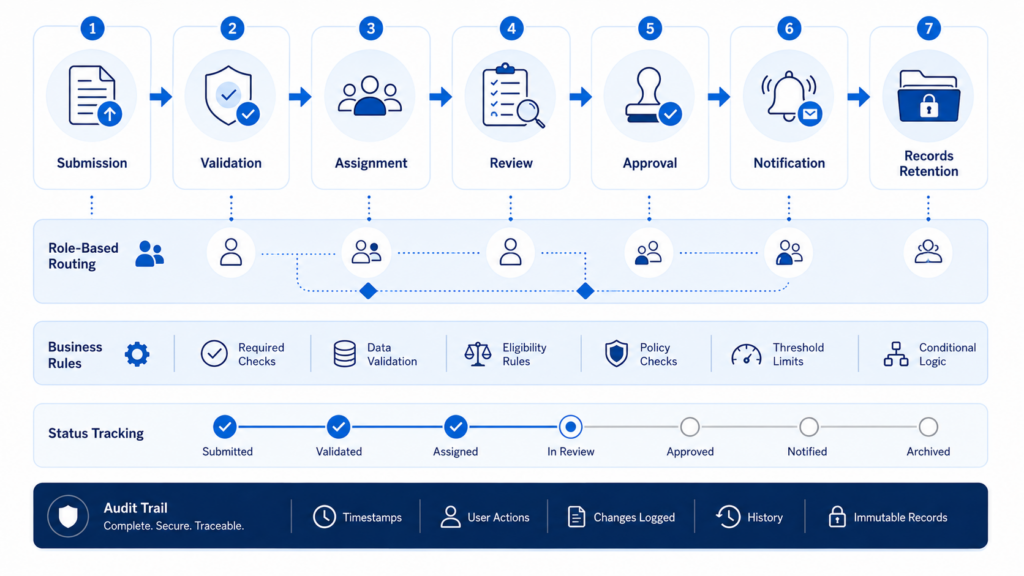
Because IIG workflows are configurable rather than hardcoded, organizations can adapt to policy changes, new legislation, program updates, and evolving operational requirements without rebuilding the entire system. This flexibility is important for agencies and regulated organizations where requirements may change over time.
Auditability and Transparency at Every Step
A strong workflow system must show not only what happened, but when it happened, who acted, and why a decision was made. IIG supports complete audit trails so organizations can demonstrate process integrity during audits, oversight reviews, appeals, and internal quality checks. Process Automation 4 of 5
This level of visibility also helps managers operate more effectively. Supervisors can monitor workloads, identify bottlenecks, rebalance assignments, and improve service delivery based on current operational data rather than outdated manual reports.
Where Process Automation Delivers Value
Process automation delivers value wherever work is repetitive, rules-driven, high-volume, or compliance- sensitive. Common examples include application intake, license renewals, document review, fee processing, case management, enforcement workflows, correspondence generation, approvals, escalations, and final dispositions.
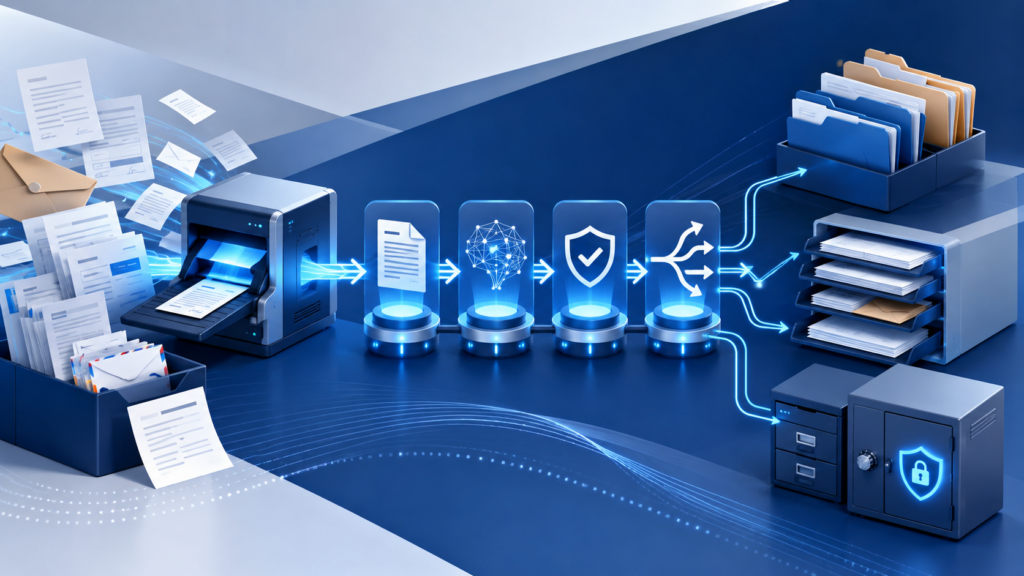
By connecting workflow automation with content management, records governance, analytics, and enterprise search, IIG helps organizations create a unified operating model. Staff can work from complete information, leaders can see performance in real time, and the organization can maintain a defensible record of decisions.
Conclusion
Process automation helps organizations replace disconnected manual activity with secure, repeatable, and auditable digital workflows. IIG provides the configurable workflow foundation needed to improve efficiency, reduce risk, strengthen compliance, and support mission-critical operations with confidence.
About IIG
Information Intelligence Group (IIG) delivers mission‑critical automation solutions that transform high‑volume, manual, paper‑based processes into secure, auditable, and scalable digital systems—supporting enterprise organizations across government and the private sector.